

(Average reading time: 4 mins)
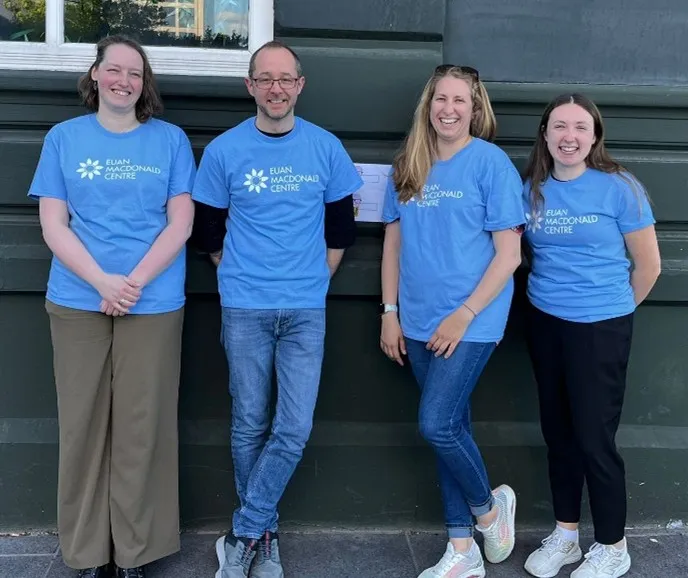
Four Euan MacDonald Centre scientists from the University of Dundee’s School of Medicine took to the stage to share how they are tackling motor neuron disease from entirely different angles.
Learn more about their experience and research in the blog below.
On Wednesday, May 20th, a packed crowd gathered at Bird and Bear on Whitehall Crescent in Dundee for a completely sold-out Pint of Science event: "Movement, Muscle, and Mind."
The mission? To bridge the gap between world-class neurodegenerative research and the Dundee community, exploring exactly what happens when the delicate biological systems controlling our muscles and movement begin to fail.
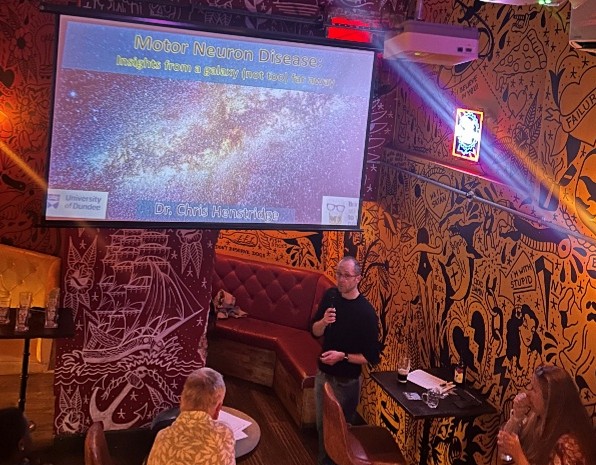
Mapping the Cellular Disconnection:
Dr Chris Henstridge kicked off the evening by taking the audience deep into the inner workings of the brain and spinal cord. Our ability to walk, speak, and breathe relies entirely on motor neurons communicating across billions of microscopic junctions called synapses.
Chris explained that synapse loss is one of the earliest changes linked to MND, occurring long before motor neurons themselves disappear. To help everyone grasp the sheer scale of a single motor neuron, Chris offered a vivid analogy: if you were to scale up the cell body to the size of a human being, its axon projection (arm) would stretch all the way from Dundee to Edinburgh! By treating the brain like a massive, interconnected galaxy, his team is working to uncover the when, where, and why of this cellular disconnection, searching for ways to protect these vital bridges before they are lost.
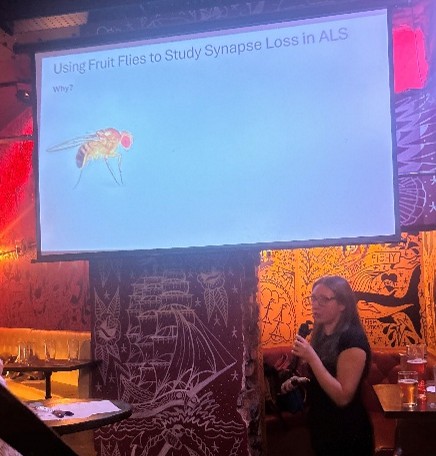
Tiny Flies, Big Answers:
Following the focus on synapses, PhD student Anna McFarlane introduced the audience to an unexpected hero in the fight against MND: Drosophila melanogaster, the humble fruit fly.
While it might seem strange to study human neurodegeneration in a fly, Anna elegantly broke down why they make such brilliant model organisms, as they share a surprising amount of genetic machinery with humans. To drive the point home, Anna shared striking videos of flies with MND, offering a clear visual demonstration of just how well these tiny creatures model the physical realities of the condition researchers are trying to treat. By utilizing these models, scientists can rapidly track the progression of symptoms and screen for "disease modifiers" that could protect synapses from degrading.
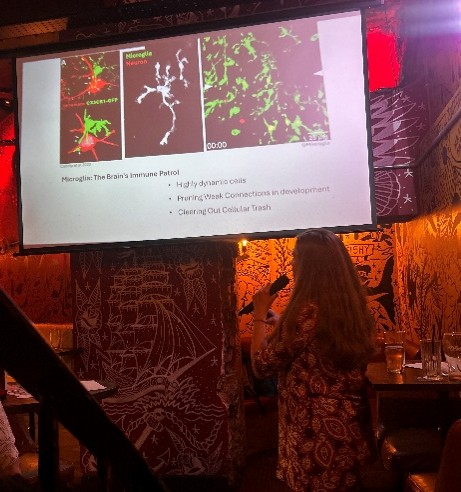
Glial Cells: Friends Turned Foes?
Next, Dr Zsofia Laszlo shifted the spotlight to the brain’s unsung supporting cast: glial cells. Normally, glia are the ultimate protectors—they nourish neurons, clean up cellular debris, and keep the brain environment pristine.
However, Zsofia revealed a dark side to these cells in neurodegenerative diseases. In a fascinating look at the cellular microenvironment, she showed how glia can pivot from being vital supporters to outright enemies. When they become chronically overactive, they inadvertently release toxic molecules and begin breaking down healthy synapses, acting as an accelerator for the disease. Understanding this toxic switch could be the key to slowing down MND progression.
A Blueprint for Hope in Genetic Medicine:
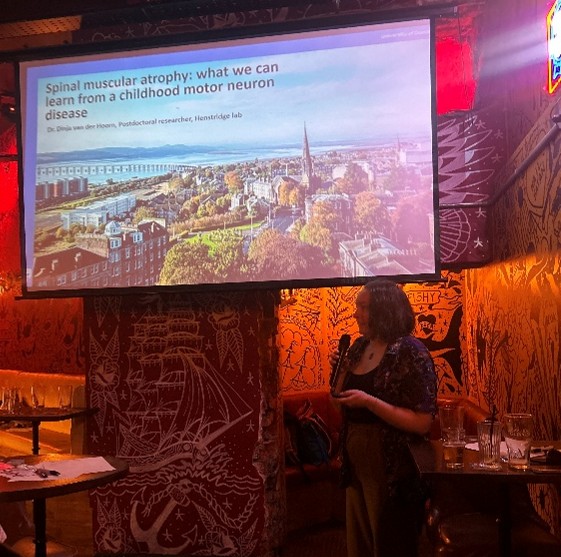
Closing out the evening, Dr. Dinja van der Hoorn brought a powerful message of therapeutic progress to the stage, focusing on Spinal Muscular Atrophy (SMA). SMA is an aggressive genetic disorder that causes progressive muscle weakness in children and has historically been fatal in early childhood.
Unlike MND, which is incredibly complex and driven by a mix of many factors, the vast majority of SMA cases stem from a single source: a mutation in a single gene (SMN1). This clear genetic target has allowed scientists to develop ground-breaking gene therapies that are already changing lives in the clinic.
Dinja nicely highlighted the jaw-dropping scale of this medical frontier by pointing out that one of these new, life-saving SMA therapies (Zolgensma) made global headlines as the most expensive single-dose drug in the world, carrying a list price of around £1.79 million. It stood as a stark reminder of both the incredible leaps being made in genetic medicine and the complex economic realities of curing rare diseases.
The Takeaway
What made "Movement, Muscle, and Mind" so impactful wasn't just the data - it was the unique atmosphere and the community it brought together. Sitting in a local venue with a drink in hand, the room hummed with a real mix of people: individuals and families personally affected by MND, curious members of the public, and local university students.
Seeing everyone interacting, asking questions, and discussing the talks directly with the researchers was a powerful reminder of how vibrant Dundee's scientific community is.
Our thanks to Chris, Anna, Zsofia, and Dinja for contributing to the blog, and for their enthusiastic participation in this important public engagement activity. Events like these play a vital role in raising awareness of MND and connecting research with the wider community.
Related links
Movement, Muscle and Mind event page on the Pint of Science website (external website)
University of Dundee research page (external website)
Find out how you can support MND Research at the Euan MacDonald Centre: Support Us webpage
Images courtesy of Henstridge Lab, University of Dundee