

(Approximate reading time 2 minutes)
At the Euan MacDonald Centre, we are proud to showcase the work and experiences of our early-career researchers. Developing the skills to communicate research beyond the laboratory is an important part of an early career researcher’s journey.
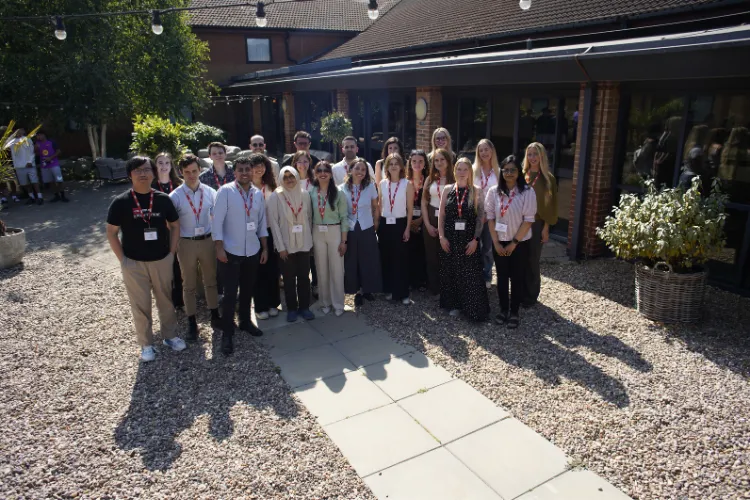
This summer, Sophie Cuthbertson, a second-year PhD researcher from the University of St Andrews, supervised by Prof Judith Sleeman and Prof Gareth Miles, attended MND EnCouRage in Loughborough. The two-day science communication workshop was organised by the Motor Neurone Disease Association. Bringing together early career researchers, senior researchers, clinicians, patients and carers from across the UK, the event provided an opportunity to share the latest advances in MND research and explore how complex scientific information could be communicated in an accessible and meaningful way to the wider MND community.
We asked Sophie to share a blog about her experience and what she learned from attending the workshop.
Sophie’s blog
This July, I was given the opportunity to attend MND EnCouRage in Loughborough, a two-day science communication workshop organised by the Motor Neurone Disease Association. The ability to effectively communicate your work to different audiences is such an important skill, but one that can easily be overlooked. MND EnCouRage provided a space to develop this area of scientific practice. Here, early career researchers, such as myself, were brought together with senior researchers, clinicians, patients and carers from across the UK to discuss our research and advancements in the field, focusing on communicating information in a format that was accessible to everyone in the MND community.
During the event, I gave a short presentation to an audience of MND patients and carers, highlighting the key concepts of my research, which looks at how targeting small changes to our proteins could make a big impact in MND. Before doing so, I was able to practise my presentation in a space where senior researchers could give me advice on how to improve the accessibility of the information I was sharing. This really helped me to develop the skills and techniques to communicate and present science with meaningful impact to a diverse range of audiences – something I will carry with me as I continue my scientific career. As well as developing my own skill set, it was inspiring to learn about the range of amazing research being carried out by the many MND laboratories across the country.
Whilst professional development is important, patients are ultimately at the heart of what we do, so I was honoured that so many patients and carers attended the event, listened to our research and discussed recent developments with us. Listening to lived experiences of MND is always eye-opening and fills me with a renewed motivation to keep pushing towards finding a cure. I am very grateful that the Motor Neurone Disease Association hosts events full of learning, community and reminders that we are all working towards the same goal – a future free of MND.
Relevant links
Discover more about the Euan MacDonald Centre
Find out how you can support MND at the Euan MacDonald Centre
Read the MND Association's news article about EnCouRage 2026 (external website)
Profile for Prof Judith Sleeman
Header image by kind permission of the MND Association